

XR, the metaverse, digital twins. These terms regularly appear in conferences, sales presentations and digital transformation roadmaps.
They are often associated with one another, and sometimes confused. Yet they do not describe the same concepts, the same uses or the same deployment requirements.
This confusion is not merely theoretical. It can lead a company to choose an unnecessarily complex solution, invest in a platform that users struggle to adopt or expect results from a technology that it was never designed to deliver.
The useful question is therefore not which of these concepts is the most innovative. It is what role each one plays, how they can work together and which business problem they can help solve.
💡 To get straight to the point, here are the key takeaways.
- XR, the metaverse and digital twins do not describe the same type of technology.
- XR provides an experiential interface through which users can view, practise or interact with digital content.
- A digital twin is a dynamic representation of an asset, process or system, connected to data from the physical world.
- A B2B metaverse is a shared digital environment in which multiple users, tools and virtual assets can interact.
- These approaches can work together, but they do not have to be included in the same project.
- The best starting point depends on the business problem, the quality of the available data and the people who will use the solution.
- A 3D model is not automatically a digital twin, and an XR experience is not automatically a metaverse.
- A focused, measurable pilot is usually more useful than an ambitious platform without a recurring use case.
Why are these three concepts so often confused?
Part of the confusion comes from the fact that these technologies can rely on the same building blocks: 3D models, real-time rendering engines, data, sensors, artificial intelligence and immersive interfaces.
The same digital representation of a factory could, for example, be viewed on a screen, explored in virtual reality, displayed in augmented reality or integrated into a collaborative environment used by several people.
At first glance, everything appears to belong to the same ecosystem. In practice, however, each concept answers a different question.
- XR answers: How will a person see, understand or manipulate the information?
- A digital twin answers: How can an asset or process be represented using real-world data?
- A B2B metaverse answers: In what environment will several people and systems interact?
Understanding this distinction helps move the conversation away from fashionable terminology and back towards a more operational approach.
XR: an interface for seeing, practising and interacting
XR, or extended reality, is an umbrella term covering several immersive technologies.
These include:
- virtual reality, which immerses the user in a fully digital environment;
- augmented reality, which adds digital information or objects to the physical world;
- mixed reality, which anchors digital objects in the physical environment and allows users to interact with them.
To explore these differences in more detail, read our dedicated guide: VR, AR, MR, XR: understanding the differences to make the right choices.
For the purposes of this article, the essential idea is simpler: XR acts as an interface between the user and digital information.
It can be used to:
- explore a building before it is constructed
- practise a technical procedure
- visualise a machine inside a workshop
- manipulate a 3D model at full scale
- guide a technician during an intervention
- collaborate around a complex design
- present a product that cannot be transported
An XR experience can operate independently. It does not need to be connected to a digital twin or a metaverse.
A virtual tour of an unbuilt apartment, for example, can be created from an architectural model. It allows the client to move through the future space, understand its proportions and compare different layouts. However, it does not become a digital twin unless it is connected to data from the physical building.
Similarly, a VR training module can recreate a safety scenario without being integrated into a broader collaborative environment.
XR therefore creates value whenever someone needs to see, understand, practise or decide more effectively.
The metaverse: from a universal promise to targeted environments
The word “metaverse” received significant media attention between 2021 and 2023. It was often presented as a new version of the Internet: a persistent virtual world in which users could work, shop, socialise and access entertainment.
This broad vision attracted substantial investment, but it also created expectations that were difficult to meet. Consumer adoption did not progress as quickly as some predictions suggested, and several companies reassessed their ambitions.
This does not mean that shared virtual environments have disappeared.
What has lost momentum is mainly the idea of a universal digital world that would quickly be adopted by everyone and replace a large proportion of existing interfaces.
In a B2B context, the term remains useful when it refers to a shared, persistent or reusable digital environment in which several people can meet, collaborate and access common resources.
A B2B metaverse may take the form of:
- a 3D collaboration space for distributed teams
- a virtual showroom accessible to clients
- a shared training campus
- a co-design environment
- a virtual trade show
- a platform connecting several simulations or digital twins
The main difference between this and a standalone XR experience lies in continuity and collective use.
A five-minute VR demonstration at a trade show is not necessarily a metaverse. By contrast, a virtual space in which employees regularly connect, access tools, manipulate models and work together is closer to this model.
The important point is not to create a virtual environment simply because the concept sounds innovative.
A shared space only creates value when users have a clear reason to return. It should make collaboration, training, demonstration or decision-making easier than it would be with existing tools.
The digital twin: a dynamic representation connected to reality
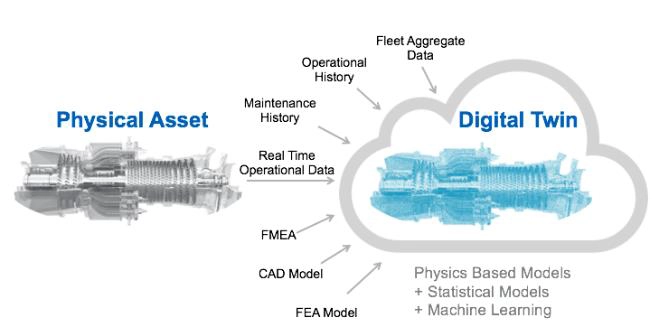
A digital twin is a digital representation of a physical asset, process or system, connected to data from the real world.
It can represent:
- a machine
- a production line
- a building
- a vehicle
- an energy network
- a warehouse
- an infrastructure asset
- a logistics process
- a system made up of several pieces of equipment
Data is essential here.
A 3D model of a machine shows its shape and components. A digital twin can go further by integrating information about its condition, use, temperature, performance, incidents or maintenance history.
Depending on its level of maturity, it can be used to:
- monitor the condition of an asset
- centralise previously fragmented data
- test scenarios without immediately intervening on the physical system
- detect deviations or unusual behaviour
- prepare a maintenance operation
- anticipate certain needs
- compare different configurations
- optimise a process
Not every digital twin offers all these capabilities.
Some are primarily used to visualise information. Others include simulations, predictive models or optimisation functions. Their level of sophistication depends on the available data, the quality of connections with existing systems and the value the organisation is trying to create.
A 3D model is not automatically a digital twin
This distinction matters.
A 3D model visually represents an object, building or piece of equipment. It can be extremely accurate and support design, presentation or training.
It becomes part of a digital twin approach when it enters into a dynamic relationship with the physical system.
In the construction industry, for example, a BIM model can contain a large amount of technical information. If it is then connected to operational data, sensors, energy consumption or equipment status, it can evolve towards a digital twin.
Visual realism is therefore not what defines a digital twin. What matters is the relationship between the representation, the data and the operational use case.
XR, digital twins and the metaverse: how do they work together?
These three concepts do not sit at exactly the same level. One simple way to distinguish them is to view them as three complementary layers.
The digital twin provides the model
It brings together the representation of an asset or system and the data required to monitor, simulate or optimise it.
XR provides the interface
It gives users a more intuitive, spatial or immersive way to access the model.
A technician could, for example, view machine data through augmented reality. An engineer could enter a simulation in VR. A team could manipulate a model using mixed reality.
The B2B metaverse provides the shared environment
It can bring together several users, tools, digital twins and workspaces within the same digital environment.
This combination can be valuable in complex projects, but it should not be seen as a mandatory progression.
A company can create value with an XR experience that is not connected to a digital twin. It can use a digital twin through a conventional dashboard without an immersive headset. It can also create a virtual collaboration space without connecting real-time industrial data.
The right architecture always depends on the need.
| Concept | Main question | Value provided | Condition for success |
|---|---|---|---|
| XR | How can users see, practise or interact more effectively? | Immersion, understanding, training, visualisation | A simple experience adapted to the user |
| Digital twin | How can data from an asset or process be represented and used? | Monitoring, simulation, maintenance, optimisation | Reliable data and connectable systems |
| B2B metaverse | How can several users and resources be brought together in a shared environment? | Collaboration, group training, co-design, presentation | A recurring use case and clear governance |
Practical examples
Training an operator on a machine
A company can create a VR simulation that allows an operator to learn a procedure without taking the physical equipment out of service.
In this case, XR is sufficient if the goal is to reproduce a predefined scenario.
If the simulation then uses real machine data, recent incidents or operating parameters, it can be connected to a digital twin.
If several operators and trainers regularly meet inside a shared environment containing different virtual machines, the project may also follow an industrial metaverse model.
The complexity increases progressively, but only when the use case justifies it.
Monitoring and maintaining industrial equipment
A digital twin can centralise information about the condition of a piece of equipment, its operating data and its history.
An AR interface can then display certain information directly beside the machine, such as the component concerned, a detected anomaly, the next step or relevant documentation.
An expert can also support the technician remotely by seeing their working environment.
The value does not come from combining several technologies. It comes from reducing search time, improving understanding of the problem and providing faster access to expertise.
Designing or presenting a building
In architecture and real estate, a 3D model can be explored in VR to help a client understand a project before construction begins.
Augmented reality can also be used to visualise the future building directly on its intended site.
You can explore these applications in more detail in our article on virtual tours for property developers and architects.
If the model is connected to building data after construction, it can later become the foundation of a digital twin used for operations, maintenance or energy monitoring.
The same digital asset can therefore evolve throughout the project. It begins as a design resource, becomes a presentation tool and can then be enriched to support building operations.
Creating a showroom or collaboration space
A company can offer an XR experience that allows users to discover a range of products in 3D.
If the experience is temporary, it is primarily an immersive showroom.
If the space remains available, regularly welcomes visitors, allows users to interact and preserves saved configurations, it becomes closer to a B2B metaverse.
In both cases, the terminology matters less than the value created: clearer understanding of the offer, more accessible demonstrations and more concrete sales conversations.
For more potential applications, read our article on 15 practical examples of XR in business.
Which approach should you choose?
The best choice does not depend on how sophisticated the technology is. It depends on the situation you are trying to improve.
| Your need | Possible starting point |
|---|---|
| Explain a product or space that is difficult to understand | XR experience, 3D visualisation or virtual tour |
| Train people for a rare, costly or risky situation | Virtual reality simulation |
| Guide someone within their working environment | Augmented or mixed reality |
| Monitor an asset and centralise its data | Digital twin |
| Test different scenarios without intervening on the physical system | Digital twin and simulation |
| Bring several experts together around a complex model | Collaborative XR |
| Create a shared space that people use regularly | Collaborative virtual environment or B2B metaverse |
| Connect collaboration, data and simulation | Digital twin accessible through a shared XR environment |
Before making a choice, four questions can help clarify the project.
- Who will actually use the solution? A technician, client, trainer, architect or engineering team will not have the same needs.
- Which decision or action should it support? Understanding a space, repeating a procedure, detecting an anomaly, approving a design or collaborating remotely.
- What data is already available? A digital twin project depends heavily on the quality, frequency and accessibility of its data.
- What is the smallest version that could already create value? A single machine, a short training module, one pilot building or a focused demonstration may be enough to begin.
What really determines return on investment
ROI does not come automatically from choosing XR, the metaverse or a digital twin. It depends on how the solution is integrated into an existing activity.
A problem significant enough to address
The project should solve a genuine point of friction: lengthy training, difficulty visualising a result, repeated errors, limited visibility, frequent travel or complex maintenance.
If the problem is inexpensive, occurs rarely or can be resolved more simply, an advanced technology will be difficult to justify financially.
Users involved early enough
A solution can be technically successful and still remain underused.
Operators, sales teams, trainers, clients and maintenance managers should be involved from the early stages. They can identify real constraints, useful information and the conditions required for adoption.
Reliable data
This is particularly important for digital twins.
A representation connected to incomplete, outdated or poorly structured data will provide an unreliable view of reality. The project should therefore address data sources, quality, update frequency and governance.
Integration with existing tools
A digital twin disconnected from the ERP, BIM model, maintenance tools, sensors or industrial systems will often remain a demonstration rather than an operational resource.
Similarly, an XR experience disconnected from the training journey or sales process may become content that is only used occasionally.
The technology needs a clear place in everyday work.
Indicators defined before the pilot begins
The indicators can be simple:
- time required to complete a task
- number of errors
- training duration
- downtime
- travel avoided
- approval time
- level of understanding
- usage rate
- number of qualified prospects
- user satisfaction.
The objective is to compare the situation before and after the project, rather than measuring only the novelty effect.
✨ XR isn’t here to impress. It’s here to be useful.
If you’d like to go further, we’ve gathered concrete XR project examples (visualize, train, engage) with realistic formats.
Common mistakes to avoid
Starting with the fashionable term
Saying “we want a metaverse” or “we need a digital twin” does not yet define a project.
The first step is to identify the situation that needs to be improved. The technology should be selected afterwards.
Confusing visual quality with operational value
A photorealistic environment may look impressive without creating much value.
By contrast, a simple interface can be extremely useful if it presents the right information at the right time.
Realism should support the use case, not become an isolated objective.
Trying to connect everything from the beginning
Immediately representing an entire factory, all its equipment and every data flow significantly increases complexity.
A more realistic approach is to begin with one critical asset, one production line, one building or one clearly defined process.
Underestimating integration and security
Projects connected to industrial, technical or customer data must address access rights, cybersecurity, confidentiality and service continuity.
These issues should not be added at the end of the project. They are part of its design.
Creating an environment without a reason to return
A virtual space may attract curiosity when it launches. Without a recurring purpose, however, it will quickly be abandoned.
A B2B metaverse only makes sense when it genuinely supports an activity such as collaboration, training, presentation, simulation or decision-making.
Conclusion: the right choice starts with the real world
XR, the metaverse and digital twins are not interchangeable, nor do they have to be combined within the same project.
- XR allows people to see, practise and interact in new ways.
- A digital twin represents an asset or system using real-world data.
- A B2B metaverse can provide a shared environment in which multiple users, tools and digital representations come together.
Combining all three can be powerful. It is only relevant, however, when each layer addresses a specific need.
The real sign of maturity is not adopting the most ambitious technology. It is choosing a level of complexity suited to the problem, the available data and the people who will use the solution.
Are you trying to determine whether your need calls for an XR experience, a digital twin or a broader collaborative environment?
A scoping workshop can help clarify the use case, identify the data and tools already available, and define an initial measurable pilot. The objective is not to add another technology to your organisation, but to choose the one that will make a situation clearer, smoother or easier to act on.
📌 Let’s see what’s truly relevant for you
We help you clarify where XR can genuinely create value, based on your context, your priorities, and your teams.