
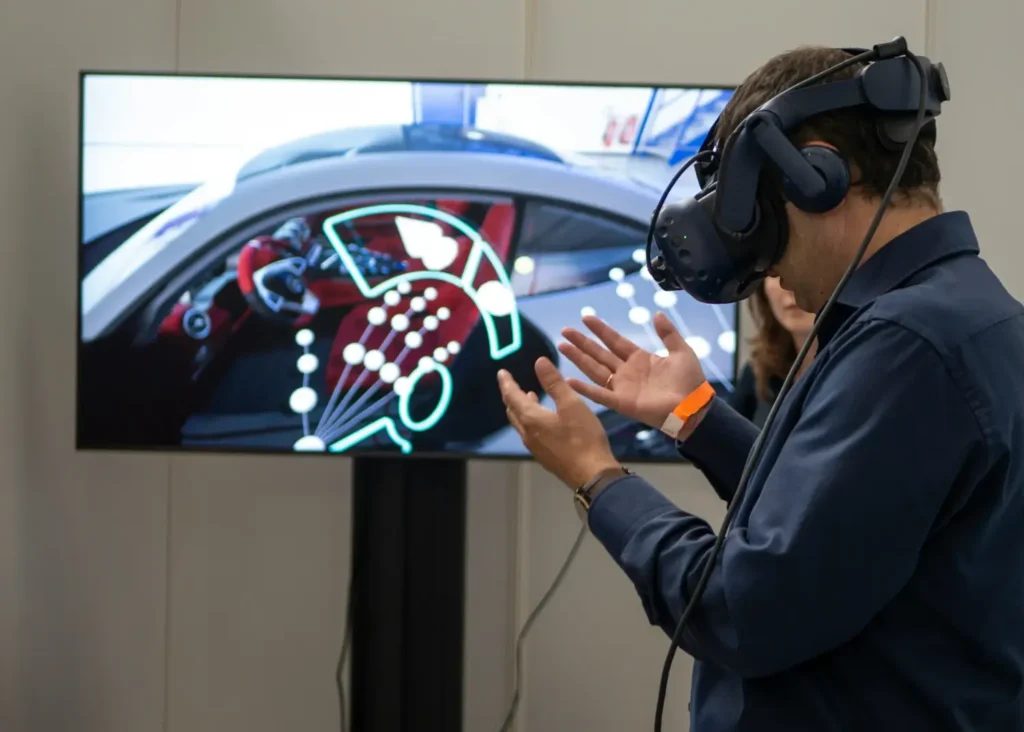

If your teams are talking more and more about XR, VR, or AR, but you still don’t clearly see what it actually changes for your business, that’s completely normal. In many cases, these technologies are still presented in an abstract way, disconnected from real business challenges. The result: people talk about them, sometimes experiment… but don’t really know what to do with them.
What is changing, however, is the speed at which they are being adopted, and the role they are starting to play in very concrete situations. This is no longer purely experimental. In certain contexts, they are already transforming how companies design products, train teams, and sell.
Understanding it today isn’t about following a trend. It’s about starting to see where it can genuinely simplify a situation, remove friction, or accelerate a decision.
💡 To get straight to the point, here are the key takeaways.
- XR does not replace your existing tools. It makes them more concrete and more effective.
- It is especially useful in situations where it is difficult to project, understand, or make decisions.
- Its main impact is reducing uncertainty. And in a business context, that changes a lot.
- The best use cases are often the simplest and closest to real-world operations.
- It’s not the technology that makes the difference, but how it addresses a real need.
- You don’t need to launch a complex project to get started. The first initiatives are often simple, focused, and progressive.
XR: understanding virtual, augmented, and mixed reality
XR, or Extended Reality, brings together several technologies that make it possible to combine digital content with the physical environment.
- Virtual reality immerses the user in a fully digital environment using a headset. It is particularly useful for simulating situations, training, or collaborating remotely under better conditions.
- Augmented reality, on the other hand, adds digital elements to the real world via a smartphone, a tablet, or smart glasses. It is already well established in uses such as retail, marketing, or field operations.
- Mixed reality goes even further. It allows digital objects to be anchored in the real environment and interacted with as if they were physically present. This is often where uses become the most interesting in industrial or design contexts.
Behind these technologies, we observe a broader movement. Computing is gradually moving beyond screens to integrate into our environment. This is also known as spatial computing, a term that is increasingly used to describe this trend.
For a decision-maker, this changes one essential thing. We no longer just look at information, we interact with it.
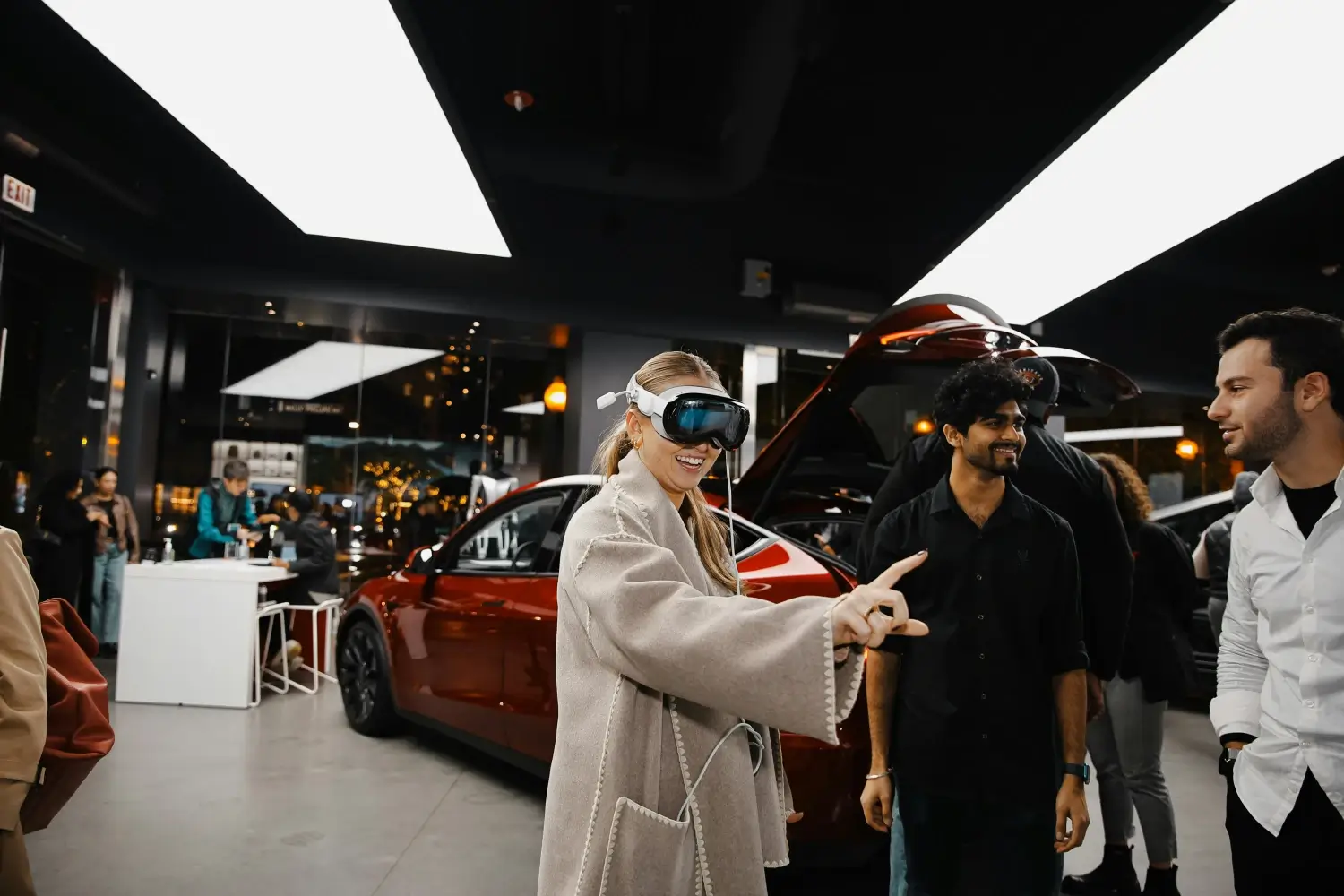
Why XR is becoming a strategic issue for companies
XR is not progressing because of hype. If it is taking hold over time, it is because it addresses problems that many companies are already facing.
According to PwC1, virtual and augmented reality could generate up to $1.5 trillion in value by 2030, particularly in training, product development, and customer experience. As is often the case with this type of projection, these figures are only indicative, but they reflect an underlying trend. But beyond projections, it is mainly the use cases that help understand its value.
XR becomes relevant as soon as there is a gap between what is explained and what is actually understood. Keep in mind: XR is not a magic solution. It involves technical decisions, production costs, and user adoption that must be planned for. In some contexts, simpler formats may still be more effective.
Some immersive experience use cases in business: training, marketing, real estate.
In product experiences, this gap is common. A product sheet or a video is not always enough to project oneself. It helps bridge this gap. Seeing a product in one’s own environment or discovering it immersively changes the way its value is perceived.
In training, the observation is similar. Reading or watching does not replace practicing. It allows people to train in conditions close to reality, to repeat, to make mistakes without consequences, and to progress more quickly.
In real estate, projection is often the main barrier. Imagining a property that does not yet exist remains difficult, even with plans or visuals. By offering an immersive visit, XR allows people to better understand spaces, project themselves more easily, and accelerate decision-making.
On the marketing side, the challenge is different. Attention has become a scarce resource. Offering an immersive experience does not guarantee success, but it changes the nature of the interaction. We no longer just capture attention, we invite participation.
What these examples have in common is quite simple: they reduce uncertainty.
And in a business context, reducing uncertainty often makes it possible to move faster, while avoiding certain costs linked to errors or hesitation.
Why XR projects fail (and how to avoid it)
In practice, the main barrier is not the technology but the way projects are initiated.
When it is approached as a gadget or an isolated experiment, the results rarely live up to expectations. Not because the technology does not work, but because it is not connected to a clear objective.
Projects that work almost always start from a very concrete situation. A point of friction. A misunderstanding on the customer side. A difficulty in training. A sales cycle that is too long.
For example, allowing a customer to visualize a product at home in augmented reality can remove an immediate barrier to purchase. Training teams in virtual reality can secure critical situations. Offering an immersive visit of a property off-plan can transform the way a buyer projects themselves.
In all cases, the logic remains the same. You start from reality. The technology comes next.
How to integrate XR into your company (without getting it wrong)
It is not necessary to launch an ambitious project from the start. In most cases, the most useful first initiatives are simple. They make it possible to learn quickly, without mobilizing significant resources.
Testing an augmented reality experience, for example, already provides valuable insights into engagement and usage. Launching a virtual reality pilot for a specific training use case makes it possible to quickly measure value. Designing an immersive experience for an event offers a first experimentation ground.
What matters is not doing something “big” right away. It is doing what is right. And above all, connecting these initiatives to your existing tools in order to measure their real impact.
How to identify XR opportunities in your company
XR does not replace what you already do. It reinforces what works and improves what does not.
The companies that get the most value from it today are not those that experiment the most. They are the ones that move forward methodically, starting from very concrete situations.
They identify specific use cases, define simple indicators, and gradually build their approach.
In practice, opportunities often appear where something is already not working smoothly.
- A product that is difficult to understand.
- Training that is not engaging.
- A customer who hesitates due to a lack of projection.
This is usually where XR becomes relevant.
So the question is no longer really whether you should test XR. The real question is often simpler. Where can it really make a difference for you?
Moving to the next step
At this stage, the challenge is not to add another technology. It is to take a moment to clarify where XR can truly create value in your context.
Identifying the right use cases, understanding their potential, prioritizing. This is what allows you to turn an intuition into a concrete approach.
In practice, it is often a few simple questions that make all the difference. Where are the friction points today? What is slowing down your teams or your customers? And where could a more immersive experience change the situation?
These are exactly the topics we work on with our clients.
If you would like to structure your thinking and identify initial concrete opportunities, we can discuss it.
📌 Let’s see what’s truly relevant for you
We help you clarify where XR can genuinely create value, based on your context, your priorities, and your teams.
- PwC, «Seeing is believing: How virtual reality and augmented reality are transforming business and the economy» available on the PwC’s site.
> Seeing is believing: How AR and VR will transform business and the economy
> VR and AR: Seeing is believing – PDF ↩︎