

Extended Reality, or XR, is no longer just an innovation topic. It is starting to become part of very concrete business use cases: training teams, selling a real estate project before construction, presenting a complex product, guiding a technician, or enriching a brand experience.
But one question often comes up before launching a project: can XR really generate a return on investment?
The answer depends less on the technology itself than on the use case. An immersive experience does not create value simply because it is spectacular. It becomes useful when it reduces a cost, speeds up a decision, improves understanding, or makes a situation safer when it would be difficult to reproduce otherwise.
We have already published an article dedicated to 15 practical examples of XR in business, exploring possible uses in training, sales, industry, and real estate. Here, the goal is different: to understand which use cases should be prioritized based on their ROI potential.
In other words: where does XR really deserve to be tested first?
💡 To get straight to the point, here are the key takeaways.
- XR brings together virtual reality, augmented reality, and mixed reality.
- Its ROI depends first on the business problem being addressed, not on the level of technology used.
- The strongest use cases are found in training, safety, real estate, sales, maintenance, and product demonstrations.
- ROI can come from cost reduction, time savings, better sales qualification, or fewer errors.
- Not all ROI is direct: some returns are commercial, educational, operational, or brand-related.
- Available figures should be read with caution: they depend on context, user volume, and the quality of the experience.
- The best starting point remains a simple, focused, and measurable use case.
XR ROI: what are we really talking about?
When we talk about ROI in XR, we should not only think about direct revenue generation. In many projects, return on investment first comes from operational or commercial gains that build over time.
XR can create value in several ways:
- reducing training time;
- limiting travel;
- reducing errors or risks;
- improving memorization;
- speeding up decision-making;
- better qualifying prospects;
- reducing unnecessary visits;
- making a complex offer easier to understand;
- strengthening engagement during a trade show or demonstration;
- improving customer or employee satisfaction.
In other words, XR ROI is not always measured with a single indicator. It is often built from a set of signals: time saved, costs avoided, better conversion, improved understanding, reduced friction.
That is why an XR project should always begin with a simple question: which indicator do we want to improve?
The different types of ROI in XR
Not all XR use cases generate the same kind of return on investment. This distinction matters because it helps avoid the wrong expectations.
An immersive training module will not be measured in the same way as a virtual real estate tour. An AR experience at a trade show will not be evaluated like remote technical assistance. The right indicator depends on the role the experience plays in your organization.
| Type of ROI | What you are trying to improve | Example indicators |
|---|---|---|
| Direct ROI | Reducing an existing cost | travel avoided, reduced training time, fewer errors |
| Commercial ROI | Improving sales or qualification | qualified leads, conversion rate, sales cycle length |
| Educational ROI | Improving transmission and memorization | assessment scores, confidence, completion rate |
| Operational ROI | Making a task more reliable or faster | intervention time, resolution rate, incidents avoided |
| Brand ROI | Creating a more memorable experience | engagement, satisfaction, media impact, event differentiation |
This framework helps set the right context from the start. XR should not be judged only by its novelty effect. It should be connected to concrete value.
What we mean by XR, briefly
XR, or Extended Reality, brings together three major families of immersive technologies.
Virtual reality, or VR, places the user inside a fully digital environment, usually through a headset. Augmented reality, or AR, adds digital elements to the real world through a smartphone, tablet, or connected glasses. Mixed reality, or MR, anchors digital objects into the physical environment with a more advanced level of interaction.
If you want to revisit the definitions, you can read our dedicated guide: VR, AR, MR, XR: understanding the differences to make the right choices.
In this article, we will focus mainly on the operational question: which use cases can truly generate a measurable return on investment?
The XR use cases most easily connected to ROI
Not all XR uses are equal when it comes to ROI. Some are highly valuable for brand image but harder to measure. Others can be connected more directly to time savings, cost reduction, or conversion.
Here is a first framework.
| Use case | Most likely ROI | KPIs to track |
|---|---|---|
| Immersive training | Time savings, higher confidence, standardization | training duration, post-test scores, completion rate |
| Workplace safety | Risk reduction, better preparation | errors avoided, reaction time, assessment results |
| Virtual real estate tour | Better projection, more qualified leads | appointment rate, time spent, qualified requests |
| AR configurator | Better conversion, reduced uncertainty | interaction rate, conversion rate, product returns |
| Sales demonstration | Better understanding, smoother sales cycle | meeting duration, qualified leads, conversion rate |
| Onboarding | Faster integration, more consistent experience | onboarding time, autonomy, internal satisfaction |
| AR maintenance | Fewer errors, less travel | intervention time, incidents resolved, travel avoided |
| Heritage and culture | Accessibility, engagement, enriched mediation | visit duration, satisfaction, content viewed |
| 3D collaboration | Fewer back-and-forth exchanges, faster decisions | approvals, meetings avoided, late-stage changes |
| B2B events | Engagement, memorization, lead qualification | interactions, scans, qualified leads, follow-ups |
This framework does not promise universal results. It provides a method: before choosing an XR format, you need to know what outcome you want to observe.
How to prioritize an ROI-driven XR project
Before looking at specific use cases, it is useful to define a simple method. An XR project may look interesting on paper, but not every project deserves to be launched first.
Four criteria are especially useful for prioritization.
| Criterion | Why it matters |
|---|---|
| Frequency of use | The more the experience is reused, the easier it is to amortize its cost |
| Current cost of the problem | ROI is more visible when errors, travel, or training already cost money |
| Ease of deployment | A simple test case reduces the risk of a first project |
| Measurable indicator | Without a clear KPI, ROI will remain difficult to defend |
A strong first XR project often sits at the intersection of these four criteria. It addresses a frequent, costly, or strategic problem. It can be tested without transforming the entire organization. And it makes it possible to measure a concrete result.
This is what prevents companies from doing XR “just to test it.” It helps build a project that is useful, defensible, and improvable.
1. Immersive professional training
Training is probably one of the most mature XR use cases.
Its value is simple: it allows employees to learn in context, instead of relying only on theoretical materials. In virtual reality, learners can repeat a gesture, make a decision, make mistakes, try again, and improve within a controlled environment.
This is especially relevant when training involves:
- a technical gesture that is difficult to master;
- a rare or dangerous situation;
- a delicate human interaction;
- a procedure that is expensive to reproduce in real life;
- an environment that is difficult to access.
PwC’s study1 on VR soft skills training indicates that learners trained in virtual reality can complete training up to 4 times faster than in a classroom and feel up to 275% more confident in applying what they learned.
These figures must be read in context: they relate to a specific soft skills training case. They do not mean that VR is always better than all traditional methods. However, they do show that VR can become highly relevant when learning relies on practice, repetition, and realistic situations.
ROI can be tracked through simple indicators:
- cost per learner;
- training time;
- completion rate;
- pre- and post-training scores;
- declared confidence level;
- reduction in errors observed in the field;
- number of learners trained per year.
So the key question is not “is VR more immersive?” It is: how much time, how many errors, or how many costs can we reduce if this training becomes more effective and more repeatable?
2. Risk prevention and workplace safety
Safety training is often difficult because the most important situations are also the hardest to reproduce.
How can you train a team to respond to a fire, a critical breakdown, a leak, an evacuation, or an accident without putting people at risk or interrupting operations? This is exactly where XR can bring value.
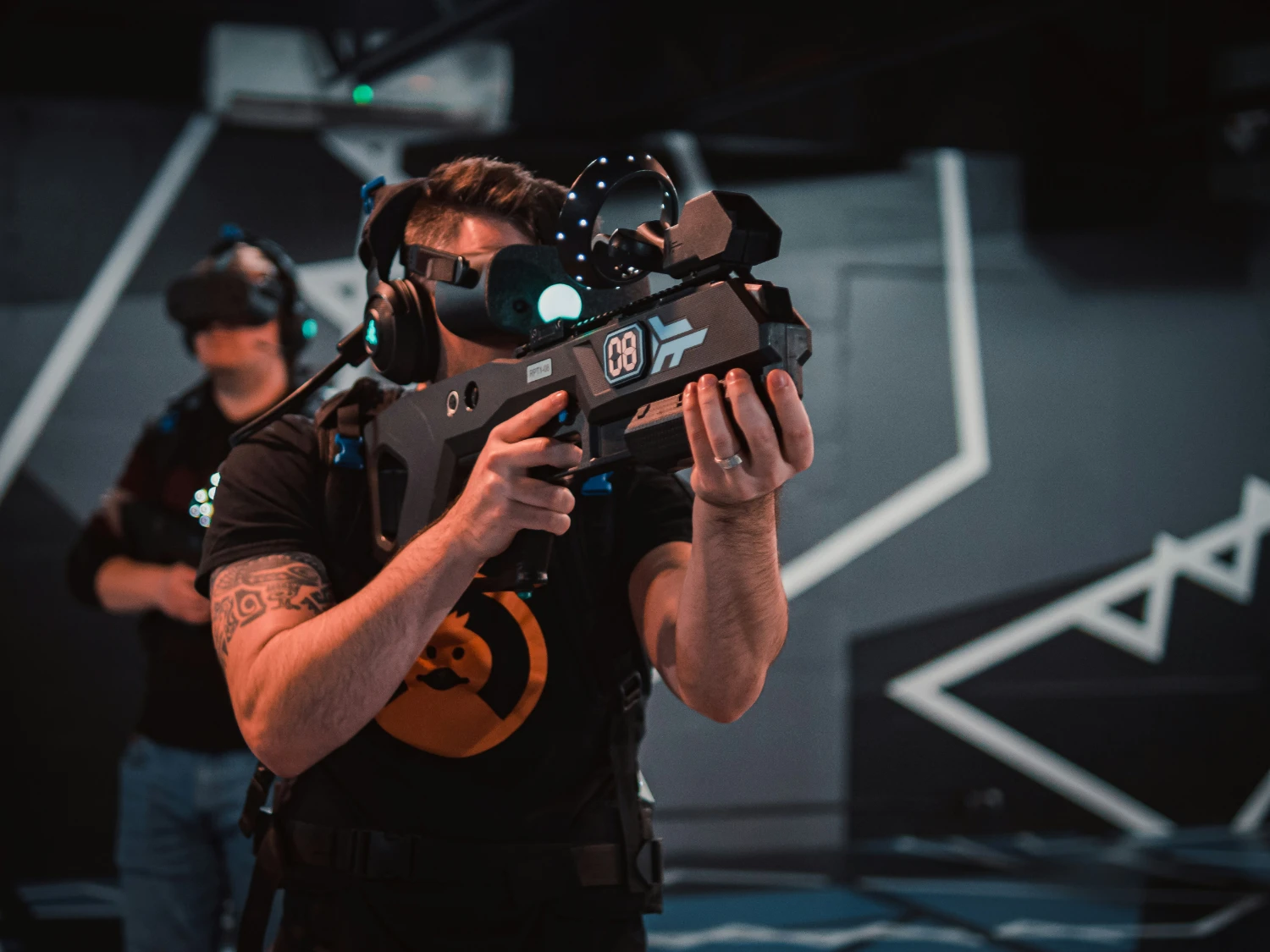
Virtual reality makes it possible to recreate high-risk scenarios in a safe environment. Learners can experience the situation, identify the right reflexes, understand the consequences of a wrong decision, and repeat the exercise until they better master the procedure.
For the company, ROI is not limited to training costs. It can also be measured through:
- fewer errors;
- better reflexes in critical situations;
- higher memorization levels;
- stronger safety assessment results;
- fewer incidents linked to poor preparation.
XR does not replace regulatory training, field instructions, or human support. It complements them by creating a more realistic training space than theory alone.
This use case is especially relevant when human error can have a high cost: industrial safety, logistics, healthcare, transportation, energy, construction, or maintenance.
3. Virtual tours for new-build real estate and off-plan sales
In real estate, one of the main barriers to decision-making is the difficulty of visualizing a project.
A buyer may understand a surface area on a floor plan but fail to feel the volumes. They may see a 3D rendering but struggle to imagine how the rooms connect. They may like a project but hesitate because the property does not yet exist.
An immersive virtual tour answers this problem. It allows users to visit an apartment, office, building, or sales space before construction. The client no longer simply looks at the project. They explore it.
In residential real estate, Zillow2 indicates that listings with a 3D tour sold, on average, 14% faster than listings without one, based on its own data. This figure should not be applied mechanically to every market, but it illustrates an important mechanism: the easier a property is to understand remotely, the easier it is for a prospect to move forward in their decision.
For a real estate developer or architect, ROI can come from several areas:
- more qualified prospects;
- fewer unnecessary visits;
- more concrete sales conversations;
- better understanding of volumes;
- fewer hesitations related to off-plan buying;
- clearer presentations for stakeholders.
In off-plan sales, XR does not replace sales advice. It makes it more tangible.
To explore this topic further, we have published a dedicated article on virtual tours for real estate developers and architects.
4. Product configurator in augmented reality
Some products are difficult to sell because they require a significant effort of imagination.
Will this machine fit in the workshop? Will this furniture suit the space? Will this equipment integrate into the client’s environment? Does this modular solution match the actual need?
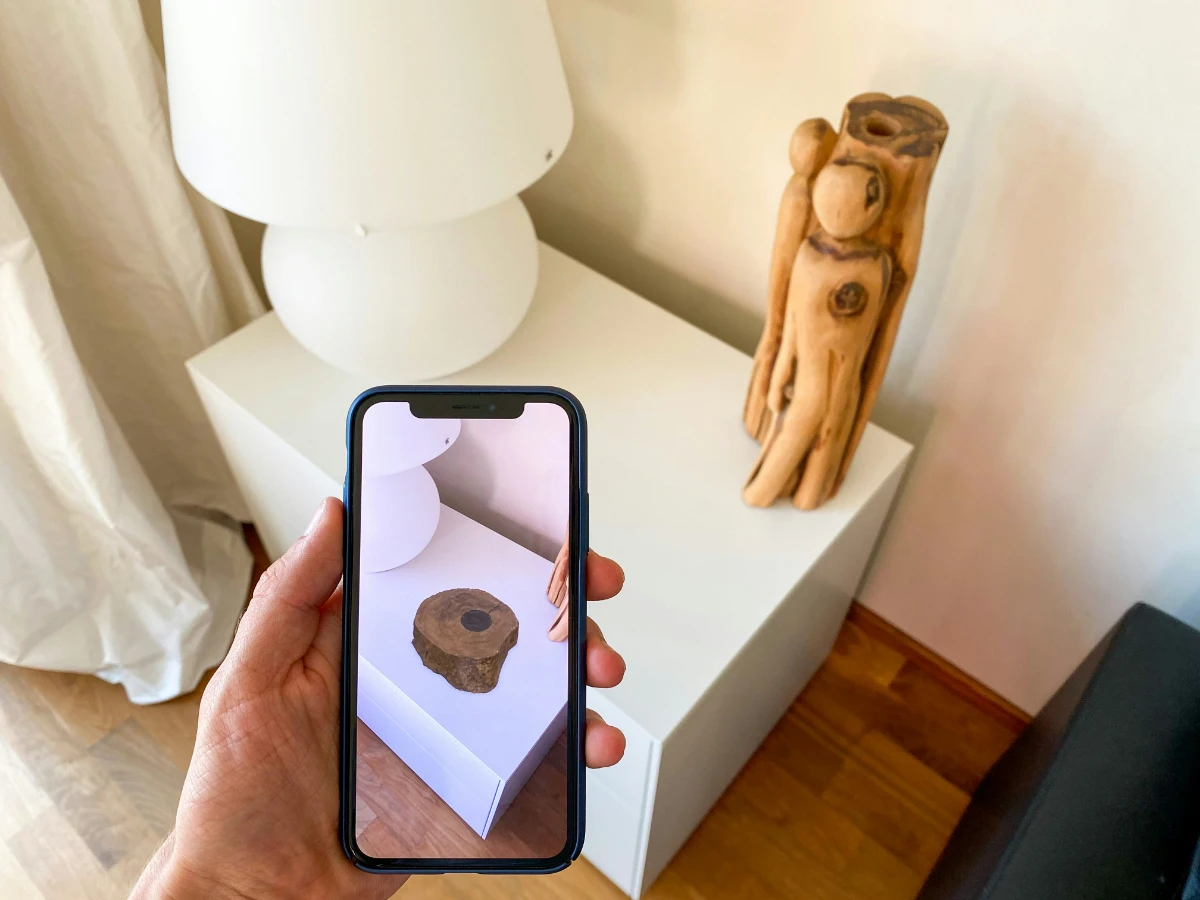
Augmented reality answers these questions by displaying a product at real scale in the client’s environment. On a smartphone or tablet, users can view the object, move it, compare variants, and better understand its footprint.
In e-commerce, Shopify3 indicates that merchants adding 3D content to their stores see, on average, a 94% increase in conversion. Here again, this figure must be contextualized: it refers to Shopify merchants and cannot be generalized to every B2B sector. But it confirms an important trend: 3D and AR can reduce uncertainty at the buying stage.
In B2B, an AR configurator can be especially useful for:
- industrial equipment;
- professional furniture;
- space planning solutions;
- technical products;
- modular systems;
- offers where size, space, or integration influence the decision.
ROI can be measured through interaction rate, quality of inbound requests, conversion rate, time spent with the product, or reduced commercial back-and-forth.
The value is not only to show a product in 3D. It is to help the client make a decision with less uncertainty.
5. Immersive sales demonstration
In many B2B sectors, the product is too large, too complex, too expensive, or too abstract to demonstrate easily.
A salesperson can explain. They can show slides. They can share a video. But sometimes, that is not enough to make the real value of the offer clear.
XR turns a demonstration into an experience. A prospect can visit a factory, manipulate a virtual machine, discover a training environment, explore a showroom, or view a project at real scale.
This use case is especially interesting when the decision involves multiple stakeholders. An immersive experience creates a shared language. It allows everyone to see the same thing, ask more precise questions, and better understand the implications of the project.
ROI can be measured with simple sales indicators:
- number of qualified leads;
- duration of demonstrations;
- appointment rate after the experience;
- progression through the sales cycle;
- conversion rate;
- quality of prospect questions.
XR does not automatically turn a prospect into a client. But it can shorten the distance between “I do not really see what you are offering” and “I understand what this could change for us.”
6. New employee onboarding
Onboarding is often underestimated. Yet poorly structured onboarding can waste managers’ time, create uncertainty for new hires, and slow down autonomy.
XR can help make this phase clearer and more engaging.
A new employee can virtually discover a site, understand safety rules, follow an induction journey, train for specific work situations, or explore key process steps before becoming fully operational.
This use case is especially relevant for:
- multi-site companies;
- industrial environments;
- retail networks;
- field-based roles;
- organizations that recruit regularly;
- roles with many procedures to learn.
ROI does not only come from reduced onboarding time. It can also come from a more consistent experience, higher confidence, fewer forgotten steps, and more gradual skill development.
To measure the impact properly, it is useful to compare several indicators before and after deployment: average onboarding duration, level of autonomy, satisfaction among new hires, recurring questions, or manager time spent.
7. Remote assistance and industrial maintenance
Maintenance is one of the areas where augmented reality can generate very concrete value.
When a technician works on site, they do not always have access to the right expert at the right time. Procedures can be long, equipment can be complex, and mistakes can be costly.
With AR, an expert can guide a technician remotely, annotate what they see, indicate a precise area, validate a step, or display instructions directly in the operator’s field of view. The goal is simple: to place the right information in the right place, at the right time.
The benefits can be significant:
- reduced intervention time;
- fewer expert travel costs;
- greater technician autonomy;
- fewer errors;
- faster incident resolution;
- smoother transfer of field knowledge.
ROI can be measured through operational indicators: average resolution time, number of avoided interventions, first-time fix rate, travel costs, maintenance errors, or machine downtime.
The value of AR here is highly practical. It is not trying to impress. It simply helps someone do their job better.
8. Heritage visualization and cultural valorization
In the heritage sector, XR answers another kind of ROI. It is not always about selling faster or reducing a direct cost. It is often about improving accessibility, mediation, engagement, and the value of a place.
Augmented reality can overlay historical information onto a building. Virtual reality can reconstruct a lost space. An immersive visit can make a fragile, remote, or partially closed site accessible.
For a museum, public authority, or heritage manager, XR can be used to:
- enrich the visit;
- make content easier to understand;
- reach remote audiences;
- prepare or extend a physical visit;
- document a site;
- create new educational formats;
- promote a place in a tourism or institutional context.
The indicators to track are not the same as in sales or training. You would look at visit duration, completion rate, visitor satisfaction, content viewed, number of remote groups welcomed, or additional revenue linked to premium experiences.
The principle remains the same: technology must serve the understanding of the place, not take over the experience.
9. Remote collaboration and co-design
XR can also help teams collaborate around content that is difficult to understand on a standard screen.
This is especially true in architecture, engineering, industry, real estate, or product design. A 3D model viewed on a screen does not always create the same discussions as a model explored at scale, in an immersive or spatial environment.
With XR, several people can gather around a model, building, prototype, or space under development. They can observe proportions, detect inconsistencies, compare options, or make decisions faster.
ROI often comes from reducing back-and-forth:
- fewer clarification meetings;
- fewer misunderstandings;
- fewer late-stage changes;
- less travel;
- faster approvals;
- stronger stakeholder involvement.
In complex projects, this gain can be significant. A better-understood decision early on can prevent costly corrections later.
10. B2B trade show and event activation
At a professional trade show, attention is limited. Visitors move quickly from one booth to another, see many similar messages, and remember little.
XR can create a stronger entry point. A VR experience lasting just a few minutes can take visitors inside a site, show a product that cannot be transported, simulate a use case, or immerse prospects in a brand environment. An AR experience can enrich a brochure, booth, model, or printed material.
But the real goal is not to attract people with a headset. The real goal is to create a useful interaction for sales teams.
A well-designed XR activation can help:
- open the conversation;
- qualify prospects faster;
- understand their interests;
- make a message more memorable;
- collect intent signals;
- extend the experience after the event.
ROI is therefore measured less by the number of people who “tried the headset” and more by the quality of leads generated, follow-up rate, meetings booked, or sales opportunities created after the event.
What these 10 use cases have in common
The strongest XR use cases share one thing: they address a limitation of traditional formats.
A PDF can explain, but it does not create lived experience. A video can show, but it does not allow users to explore. A sales presentation can convince, but it still requires the audience to project themselves mentally. Theoretical training can transmit a rule, but it does not always recreate the pressure of a real situation.
XR becomes relevant when the user needs to see, try, feel, manipulate, or decide in a context closer to reality.
That is why it works particularly well in three situations:
- when a topic is complex to understand;
- when a situation is risky or costly to reproduce;
- when a client or employee needs to project themselves before taking action.
However, if the need is simple, if a video is enough, or if the experience is not linked to a measurable objective, XR risks becoming a gadget.
How to choose the right use case to start with
Before launching an XR project, it is useful to answer four questions.
1. What business problem do you want to solve?
XR should not be the starting point. The starting point should be a clear friction.
For example:
- our prospects do not fully understand our offer;
- our clients struggle to visualize the result;
- our training is too theoretical;
- our technicians depend too much on remote experts;
- our physical visits are too numerous and poorly qualified;
- our teams take too long to validate a project.
A good XR use case always begins with an already identified difficulty.
2. Who will use the experience?
A project designed for 30 decision-makers at a trade show should not be approached like a training module for 1,000 employees.
User volume directly influences ROI. The more reusable the experience is, the easier it is to amortize production costs. This is especially true for training, onboarding, maintenance, and repeated sales demonstrations.
3. Which indicator will prove the value?
Without an indicator defined before launch, it will be difficult to demonstrate ROI afterward.
Depending on the use case, you can track:
- training time;
- assessment scores;
- number of errors;
- intervention time;
- conversion rate;
- number of qualified leads;
- time spent in the experience;
- user satisfaction;
- travel avoided;
- reduction in sales cycle length.
The indicator does not need to be complex. It simply needs to be connected to the project’s objective.
4. What minimum version can already create value?
An XR project does not need to be complete from the start.
A first version can be enough to test value: a short training module, a virtual tour of a strategic unit, a product demonstration at a trade show, an AR procedure on a critical machine, or an immersive showroom prototype.
This progressive logic reduces risk. It allows you to measure, learn, and expand only if the results are convincing.
✨ XR isn’t here to impress. It’s here to be useful.
If you’d like to go further, we’ve gathered concrete XR project examples (visualize, train, engage) with realistic formats.
Mistakes to avoid
The first mistake is launching an XR project “just to see.” This is often the best way to create an interesting experience that is difficult to integrate into a commercial, educational, or operational journey.
The second mistake is aiming for the most impressive experience. In reality, the best solution is often the clearest one. A simple AR experience on a smartphone can sometimes create more value than a very ambitious VR setup, if it responds better to the need.
The third mistake is not involving end users. An experience designed only by an innovation or marketing team may miss real field constraints. Salespeople, trainers, technicians, clients, or visitors should be involved early in the process.
The fourth mistake is measuring only the novelty effect. An XR experience can impress people in the first few minutes. But that is not enough. What matters is what it changes in understanding, decision-making, or action.
Conclusion: XR ROI comes from usefulness
XR can generate a real return on investment, but not magically.
It becomes profitable when it responds to a clear need, integrates into an existing journey, and improves a concrete indicator: training faster, reducing risk, qualifying a prospect, speeding up a decision, avoiding travel, explaining a project better, or making an offer more tangible.
That is why the best XR projects do not begin with a technology. They begin with a field situation.
An employee needs to learn a sensitive gesture. A prospect needs to understand a complex solution. A buyer needs to visit a property that does not yet exist. A technician needs guidance at the right time. A team needs to validate a project at scale.
This is where XR finds its rightful place: not as a spectacular tool, but as a lever for clarity, projection, and decision-making.
Want to identify the most profitable XR use cases for your business?
A successful XR project starts with proper framing. At Black Centauri, we help you identify the most relevant opportunities, prioritize use cases, and define the indicators to track before launching a pilot.
The goal is not to adopt XR just to follow a trend. It is to understand where immersion can truly simplify, accelerate, or strengthen your customer, sales, or learning journey.
A framing workshop often makes it possible to map your first use cases, estimate their level of complexity, and build a realistic roadmap adapted to your goals, teams, and budget.
📌 Let’s see what’s truly relevant for you
We help you clarify where XR can genuinely create value, based on your context, your priorities, and your teams.