
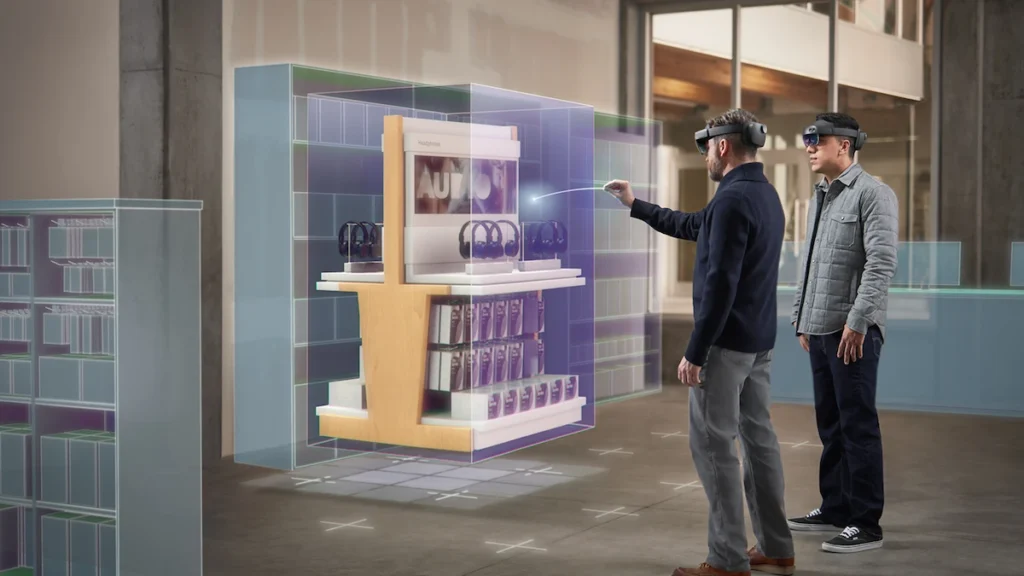
Augmented reality, mixed reality. The two terms are often used interchangeably. At first glance, the confusion makes sense: in both cases, digital content is layered onto the real world.
But in practice, the difference is significant. Because this is not just about technology. It determines what your users can actually do: visualize, understand… or interact, simulate, and make decisions.
And in very concrete terms, that directly affects your investment decisions.
💡 To get straight to the point, here are the key takeaways.
- Augmented reality and mixed reality are not just different technologies, they enable fundamentally different types of experiences.
- AR is ideal for showing, projecting, and helping users quickly understand a product, space, or concept.
- MR becomes relevant when users need to interact with digital content in a real-world environment, with precision.
- In marketing, AR is typically used to capture attention and drive engagement, while MR is more effective for high-value demonstrations and decision-making.
- In real estate, architecture, and training, MR adds value when validation, coordination, physical interaction, or safety are critical.
- The line between AR and MR will continue to blur, but the distinction remains useful to choose the right level of interaction for your use case.
AR vs MR: a simple difference with major implications
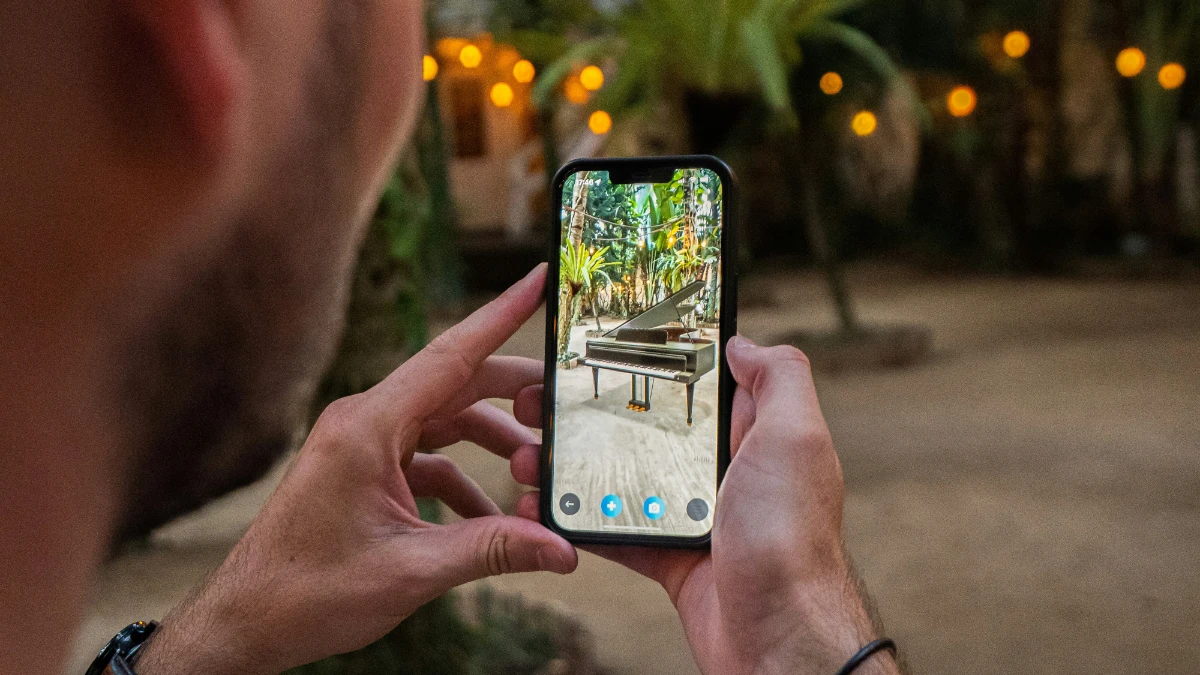
Augmented reality (AR) adds digital elements to your real-world environment through a smartphone, tablet, or lightweight glasses. These elements are visible, useful, and often impressive. But they still sit on top of reality rather than truly understanding the space around them.
That is the case in many marketing experiences, product visualization tools, and real estate projection apps. Think of Pokémon GO or a Snapchat filter.
Mixed reality (MR) goes a step further. Thanks to real-time 3D mapping and advanced sensors, digital objects are no longer simply displayed. They are anchored in the environment and interact with it. You are not just looking at an object anymore. You can manipulate it, move around it, and test how it behaves.
And that shift is exactly what changes both the nature of the use cases and the value you can get from them.
The tipping point: visualizing vs interacting
The difference between AR and MR comes down to one question: does your user simply need to understand information, or do they need to act on it within a real-world space?
- If the goal is to show, project, or explain, AR is enough
- If the goal is to manipulate, test, or validate, MR becomes necessary
This is not just a technical nuance. It is an experience design choice. And in a B2B context, it is very often a performance and ROI decision.
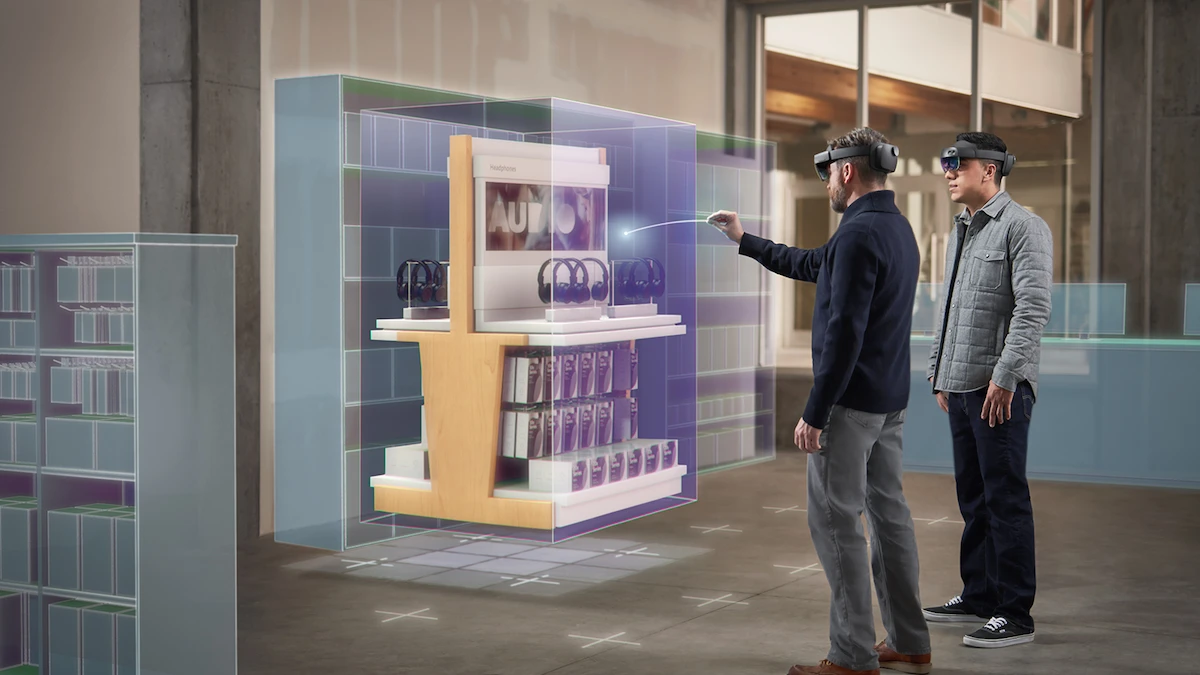
The Milgram continuum: where the confusion comes from
To move past the confusion, researchers often refer to a foundational model: the Milgram continuum (1994). This model represents a continuous spectrum between two extremes:
- On the left: the real world, as you perceive it
- On the right: virtual reality (VR), a fully digital environment
- In the middle: “mixed reality” in the broad sense, which includes both augmented reality (light digital overlays) and augmented virtuality (virtual environments enriched with real-world elements)
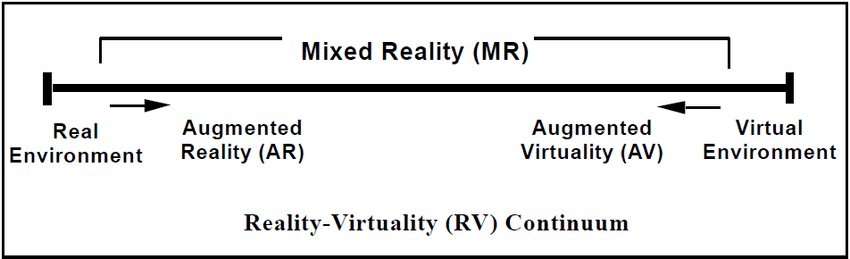
Within this framework, augmented reality is technically a form of mixed reality, but a less advanced and less interactive one. The MR we know today through devices such as Microsoft HoloLens or Apple Vision Pro sits at the far end of that spectrum: a deep fusion of physical and digital worlds that can be applied in demanding professional environments.

| Augmented Reality (AR) | Mixed Reality (MR) | |
|---|---|---|
| Core principle | Digital overlay on the real world | Interactive blend of physical and digital |
| Interaction | Visual, limited | Gesture-based, spatial, real-time |
| Spatial awareness | Low to none | Precise 3D mapping of the environment |
| Typical hardware | Smartphone, tablet, lightweight glasses | Specialized headsets (HoloLens, Vision Pro) |
| Accessibility | Very broad | More limited, higher cost |
| B2B use cases | Sales presentations, fast visualization | Technical training, construction, collaborative design |
Distinct use cases depending on your industry
Marketing: capturing attention vs driving conviction
Augmented reality is now the default choice for most marketing campaigns. It enables frictionless experiences directly on a smartphone. That makes it a powerful lever for capturing attention, helping prospects picture the offer, and increasing engagement. With AR, you can quickly deploy:
- smartphone-based experiences triggered by a QR code scan,
- at-home product try-ons or previews for machinery, furniture, packaging, or point-of-sale materials,
- immersive filters and effects for social media or live events.
MR comes in at a different stage of the journey and becomes more relevant in advanced demonstration settings, immersive showrooms, and trade shows using headsets, where the goal is to let prospects physically interact with a product or concept.
In reality, the two do not compete. A strong strategy combines them: AR to generate interest and traffic, MR as a premium experience to convert the most engaged leads.
Real estate and architecture: projecting vs validating
In these industries, the distinction is closely tied to the stage of the project.
Augmented reality helps make a project tangible early on: on-site visualization, full-scale projection, and support for sales and pre-marketing.
Mixed reality becomes relevant once the project moves into a more concrete and operational phase: coordination, verification, and control. On a construction site, the ability to overlay a BIM model onto the existing environment and identify discrepancies in real time can significantly reduce errors.
Two different tools, for two different moments in the project lifecycle.
Training and heritage: when AR is enough, and when MR becomes essential
In training and heritage, the challenge is not just creating a wow effect. It is about learning effectiveness, safety, and the perceived value of the experience.
For technical training, MR makes it possible to simulate actions on real equipment, with 3D instructions anchored in the physical environment, such as:
- safety simulations where the learner is in a real workshop or job site with virtual elements placed exactly where they need to be,
- reconstructions of machines, structures, or lost parts of a monument at full scale, with which users can interact.
For cultural or built heritage experiences, augmented reality is often enough and much easier to deploy. It can recreate a vanished monument, overlay historical information onto an existing facade, or make a visit more immersive. A few examples:
- augmented visitor journeys in a museum or heritage site, accessible on a smartphone,
- AR-enhanced manuals or quick-reference guides for technicians,
- lightweight gamified scenarios designed to raise awareness without major hardware investment.
In many cases, AR is enough to inform and guide. MR becomes justified as soon as gesture, posture, or position in space is directly tied to safety or performance.
✨ MR and AR isn’t here to impress. It’s here to be useful.
If you’d like to go further, we’ve gathered concrete MR/AR project examples (visualize, train, engage) with realistic formats.
Is mixed reality just AR 2.0?
This is the real question many people are asking: is mixed reality simply an improved version of augmented reality? And as AR glasses become more powerful, does MR still have a distinct future?
The answer is more nuanced: the boundaries are blurring, but the use cases remain distinct.
On one hand, technological progress is bringing the two closer together. CES 2026 confirmed that lightweight AR glasses are becoming more powerful and more interactive. According to IDC, 2025 marked a turning point, with smart glasses gaining traction because they are better suited to everyday use than immersive headsets.
On the other hand, mixed reality still holds a clear technical advantage for demanding use cases where spatial precision and physical interaction are non-negotiable. The global MR market, estimated at $9.27 billion in 2025, is expected to reach $142 billion by 2034, with an annual growth rate of more than 35%1. That trajectory points to sustained adoption in professional environments.
Omdia’s analysis2 is especially insightful. In the long run, immersive MR glasses are expected to become the dominant XR platform, following a transition phase driven first by lightweight AI glasses, then AR glasses. In other words, MR is not disappearing in favor of AR. The opposite is more likely: tomorrow’s AR will gradually evolve into MR as glasses gain spatial sensors and more advanced interaction capabilities.
Convergence is already underway. Standards such as OpenXR and WebXR are making interoperability between devices easier. Within the next five to ten years, the distinction between AR and MR may become less about separate categories and more about the level of interaction being delivered.
In mainstream language, the term “mixed reality” may eventually fade in favor of simpler expressions such as “augmented reality” or “spatial experiences.” But from a use-case perspective, the distinction will remain highly relevant.
What to keep in mind
Mixed reality is not “augmented reality 2.0.” It is a different approach to the relationship between the physical and the digital world, more demanding but also far more powerful in professional settings.
To choose between AR and MR, ask yourself one simple question: does your use case require spatial interaction, or is a visual overlay enough? If the answer is interaction, MR is the natural fit.
Going further
If you are asking that question, chances are you already have a real use case in mind. We can help you quickly identify where these technologies create real value in your context, and just as importantly, help you avoid unnecessary investment. Let’s talk.
📌 Let’s see what’s truly relevant for you
We help you clarify where MR/AR can genuinely create value, based on your context, your priorities, and your teams.
- Fortune Business Insights, Mixed Reality Market Size, Share & Industry Analysis, By Component (Hardware, Software), By Application (…) and Regional Forecast, 2026–2034, report n°101783, lasy updated March 30, 2026, https://www.fortunebusinessinsights.com/industry-reports/mixed-reality-market-101783. ↩︎
- Omdia, XR Market in 2035 and Beyond: Forecast, Challenges, and the Road to Mass Adoption, May 14, 2025, https://omdia.tech.informa.com/om135790/xr-market-in-2035-and-beyond-forecast-challenges-and-the-road-to-mass-adoption. ↩︎