
You may have already seen sales teams giving tours of an apartment that doesn’t yet exist using a headset, or employees training for complex situations without leaving their workplace.
These use cases are no longer science fiction. They rely on a precise technology that is now accessible. But before discussing use cases, one question needs to be asked: how does a virtual reality headset actually work? Understanding what happens “under the hood” helps better assess relevant use cases, production constraints, and the level of experience quality you can realistically deliver.
The goal of this article is simple: to explain, in clear terms, what concretely happens inside a virtual reality headset, and what that means for your VR and AR projects.
💡 To get straight to the point, here are the key takeaways.
- A VR headset relies on stereoscopy: two images recreate depth and create a sense of presence.
- Immersion depends on a complete system: display, lenses, sensors, audio, and computing power.
- 6DoF tracking accurately reproduces movement in real space within the virtual environment.
- Interaction (controllers, hand tracking, spatial audio) turns the user into an active participant.
- Quality depends on key technical factors: smoothness, IPD, tracking, and rendering optimization.
- Business value comes from concrete use cases: demos, training, visualization, and decision-making.
The 5 key components of a VR headset
To create this sense of immersion, a virtual reality headset relies on several elements that work together in real time:
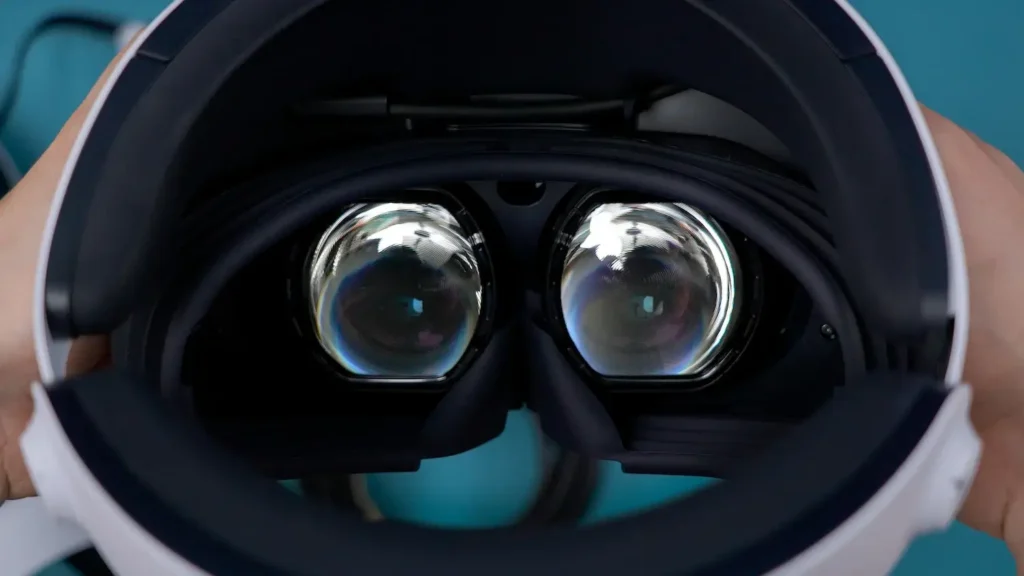
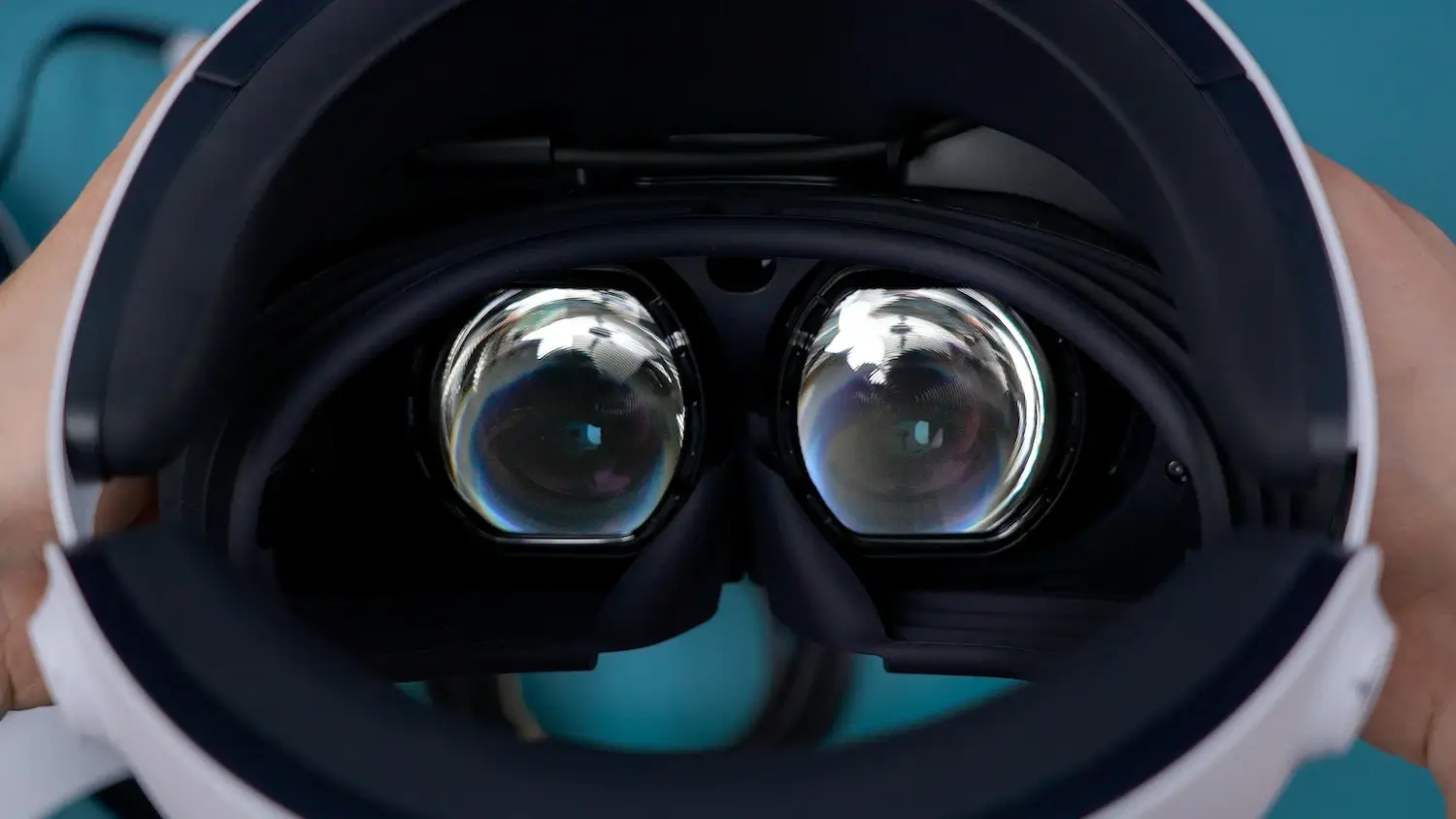
- The display: it is divided into two zones, one for each eye, to show slightly different images. This is called stereoscopic vision. The higher the resolution, the sharper the image, and the more credible the experience feels.
- The lenses: they widen the field of view and allow the images to be properly focused. They are what create the sense of depth and volume.
- Motion sensors: they precisely track the position of the headset and controllers, continuously. Every head movement is instantly taken into account to adjust the displayed image, making the experience fluid and natural.
- The audio system: it does more than just add sound. It plays a full role in immersion by recreating a coherent sound environment. In collaborative use cases, it also becomes a communication tool between users.
- The computing unit: whether built into the headset or external on a computer, it plays a central role. It must be powerful enough to maintain a refresh rate of at least 90 frames per second, a key threshold to ensure comfort and avoid discomfort.
Virtual reality: a technology that tricks the brain
A virtual reality headset, also known as an HMD (Head Mounted Display), relies on a simple but powerful principle: displaying two slightly different images, one for each eye, on a screen placed just a few centimeters from your eyes.
Between these screens and your eyes, lenses adjust the focus and add depth to the image. This mechanism, called stereoscopy, recreates a sense of relief. The brain then does the rest: it interprets these images as a three-dimensional environment in which the user feels truly present.
Most VR headsets offer a field of view between 90 and 110 degrees, covering a large portion of the natural human field of vision. Some high-end models go even further to enhance this sense of immersion.
In practical terms, this means the 3D software must calculate the scene twice, from two slightly different points of view. This requirement demands more computing power than a standard display, but it is essential. It is what creates a true sense of volume, which is critical for immersive tours, product demonstrations, or architectural visualization in virtual reality.
How the headset tracks movement in space
Displaying a high-quality image is not enough. For the experience to feel credible, the virtual environment must react instantly to every movement of the head and body.
Inside the headset, several sensors are at work (gyroscope, accelerometer, sometimes magnetometer). They continuously measure head rotation and allow the system to know precisely whether you are looking left, right, or down.
The most recent headsets go even further. They include cameras that analyze the space around you. Thanks to real-time mapping algorithms, known as SLAM, the headset identifies volumes, walls, and objects, and reconstructs a representation of your environment. By combining this information with sensor data, it can determine your exact position in the room. If you take a few steps forward in your living room, you move in the same way in the virtual environment.
This is known as “6 degrees of freedom” (6DoF) tracking. In practical terms, the system understands both where you are looking and where you are located in space. This level of precision is what changes the quality of the experience. In an architectural walkthrough or a safety training simulator, you can lean, move closer to a detail, or walk around an obstacle, just as you would in a real situation.
How the user interacts
Immersion does not rely on vision alone. It truly comes to life when the user can interact with the environment.
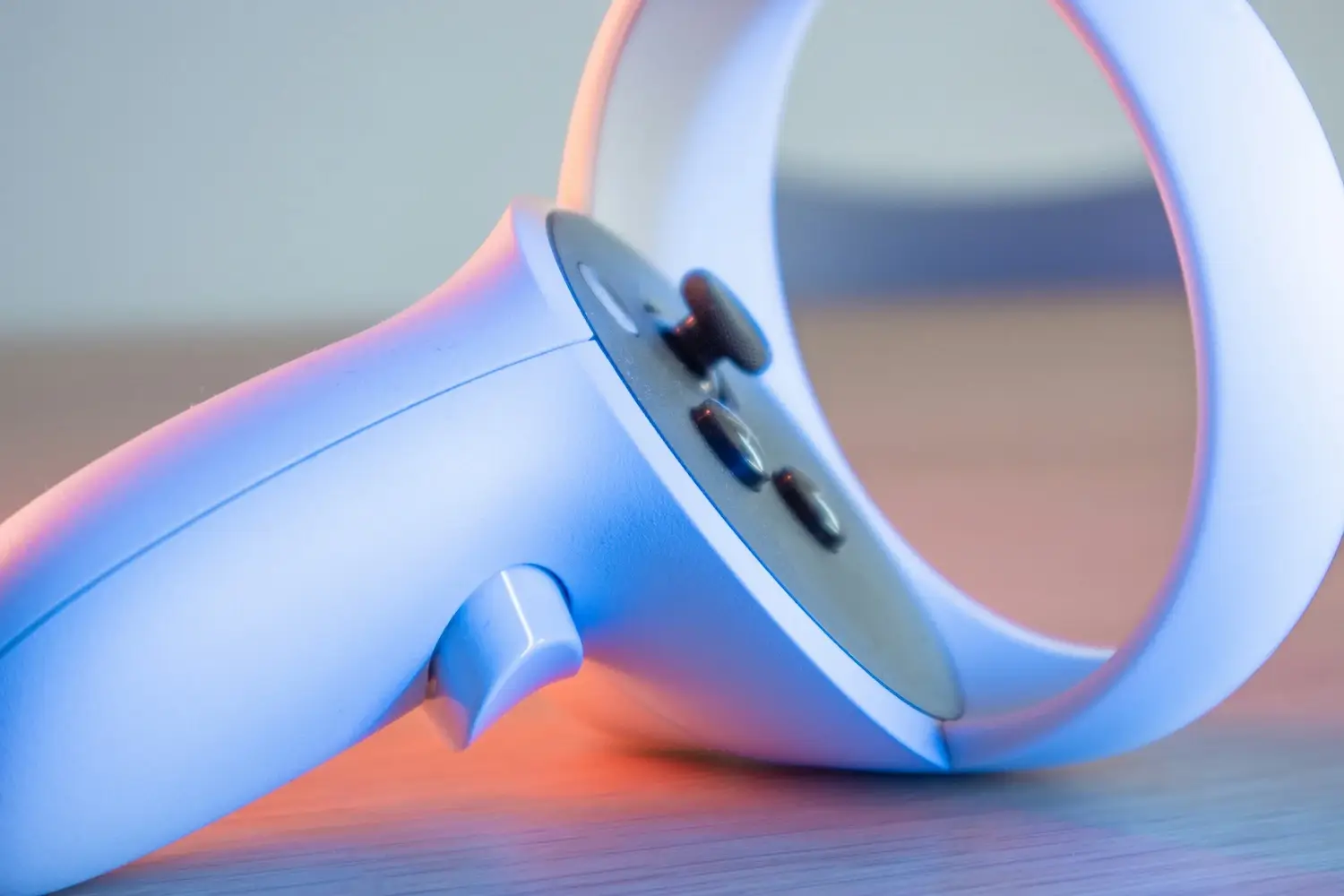
VR controllers translate hand movements into concrete actions within the virtual space. Grabbing an object, pointing at an element, moving around… each gesture becomes intuitive. Some headsets go even further by integrating hand tracking, allowing users to manipulate elements directly with their hands, without controllers.
Audio also plays a key role. Spatial sound reinforces the sense of presence, as the brain naturally associates what it sees with a coherent sound source in space.
In a B2B context, this ability to interact fundamentally changes the experience. During a virtual tour of a real estate project, a heritage visualization, or a training module, the user no longer just watches content. They act within it, move freely, observe at real scale, and understand volumes and challenges more quickly.
What makes a good experience
Not all virtual reality headsets are equal. The perceived quality largely depends on technical parameters that directly impact comfort and the credibility of the experience.
For example, the distance between the lenses must be adjusted for each user. Meta points out that setting the IPD, the interpupillary distance, is essential to achieve a sharp image and avoid visual fatigue.
Display smoothness is just as important. Higher refresh rates reduce motion blur and improve perceived stability. This is why high-end headsets emphasize higher refresh rates, ensuring a more comfortable experience.
On more advanced devices, eye tracking opens up new possibilities. This technology enables the use of foveated rendering. In practice, the system concentrates the highest image quality exactly where the user is looking, while reducing the level of detail in the periphery. The result is a more efficient visual experience and optimized computing load, with gains that can reach 30 to 50% according to Varjo.

✨ XR isn’t here to impress. It’s here to be useful.
If you’d like to go further, we’ve gathered concrete XR project examples (visualize, train, engage) with realistic formats.
Why this matters for businesses
Understanding how a virtual reality headset works helps design more relevant and, above all, more effective experiences.
In marketing, a product demonstration or immersive experience does not rely solely on a “wow effect.” Its value depends directly on the quality of tracking, visual fluidity, and interaction ergonomics. Without these fundamentals, the experience loses credibility and can quickly be perceived as a gimmick.
In architecture, real estate development, and heritage visualization, VR allows companies to take a step further. It makes it possible to visit a place before it is built, compare different layout options, and engage a client or decision-maker at real scale. Meta also highlights the value of mixed reality for collaborating directly on 3D models, while industry specialists emphasize the impact of spatial visualization in accelerating project understanding and decision-making.
In training, the technical logic of the headset also explains its pedagogical value. Immersion, repetition, immediate feedback, real-life simulation… these elements create learning conditions that are difficult to replicate otherwise. A study by PwC1 on soft skills training shows, for example, that VR learners complete training up to 4 times faster than in classroom settings, and that VR becomes the most cost-effective modality as deployment scales.
Key takeaways
A virtual reality headset works as a complete system. It displays two images to recreate depth, tracks head and hand movements, and adjusts the environment in real time to maintain the sense of presence. The more precise the tracking, the smoother the display, and the more natural the interactions, the more useful and concrete the experience becomes in a professional context.
For a company, the real question is not only “how does a VR headset work?” but rather “which use case truly deserves this level of immersion?” That is where value lies.
In most cases, the right approach is to start from a concrete need. A sales demonstration, a real estate project walkthrough, a safety training module, a heritage mediation experience. Then design a first simple, measurable experience to validate impact before scaling.
If this article helps inform your thinking on immersive content, the next step is to identify one priority journey to transform into a VR experience, and then assess its real value in terms of engagement, understanding, or conversion.
Go further
Are you wondering whether virtual reality is relevant for your business?
Rather than starting from the technology, we help you start from your business challenges. Together, we identify the key moments in your customer journey or internal processes where immersion can truly create value.
The goal: design a first useful, measurable experience adapted to your constraints, before considering a broader deployment.
Let’s discuss your project and identify a first concrete use case to prototype.
📌 Let’s see what’s truly relevant for you
We help you clarify where XR can genuinely create value, based on your context, your priorities, and your teams.
- PwC (2020). Study into the effectiveness of VR for soft skills training – PwC immersive‑technologies. https://www.pwc.co.uk/services/technology/immersive-technologies/study-into-vr-training-effectiveness.html ↩︎